

Secretary-General of the National Commission for UNESCO Visits the ۳۷th National Handicrafts Exhibition
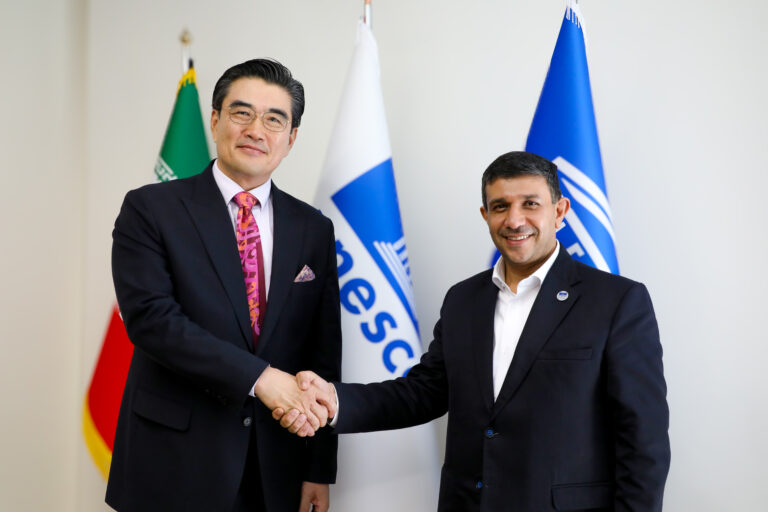
Dr. Hassan Fartousi, Secretary-General of the National Commission for UNESCO in Iran, on the sidelines of his visit to the National Handicrafts Exhibition, stated: “The key issue is how to capitalize on the benefits associated with UNESCO’s Seals of Excellence (2001–2014) and the designations of historic, national, and world cities. This is an issue that the cultural authorities of the provinces and the country, and consequently the National Commission for UNESCO in Iran, must address.”
On the second day of the 37th National Handicrafts Exhibition in Tehran, held from 13 to 16 November 2024 at the Tehran International Permanent Fairground, Dr. Hassan Fartousi, Secretary-General of the National Commission for UNESCO in Iran, visited the exhibition and emphasized the importance of the national and international registration of cities that meet the relevant criteria in the field of handicrafts. He stated that the national and international designations of cities respond to public demand and help bring the craftsmanship of Iranian artisans to greater national and international visibility.
At the invitation of Dr. Rahim Khaki, Director-General of the Alborz Province Department of Cultural Heritage, Tourism and Handicrafts, Dr. Fartousi visited the province’s pavilion, where discussions were held on ways to strengthen cooperation between the National Commission for UNESCO in Iran and the Department of Cultural Heritage, Tourism and Handicrafts of Alborz Province. Dr. Khaki subsequently invited the Secretary-General and members of the Commission to visit Alborz Province, calling for closer and expanded cooperation with the Commission and emphasizing that such cooperation is among the Department’s key priorities.
Dr. Fartousi also visited the pavilion of Khuzestan artisans and, in an interview with Khuzestan Radio, noted that despite the province’s rich artistic potential and considerable capacities in handicrafts, an important issue that deserves attention is how the benefits of obtaining the UNESCO Seals of Excellence (2001–2014) or the prestigious designations of historic, national, and world cities are subsequently utilized. He emphasized that this matter should be prioritized by the relevant authorities and that, through concerted efforts, solutions for achieving tangible and beneficial outcomes should be developed with the support and capacities of the National Commission for UNESCO in Iran.
At the conclusion of his interview with Khuzestan Radio, the Secretary-General of the National Commission for UNESCO in Iran stated that, by making use of all available capacities and with the cooperation of officials and stakeholders at the Ministry of Cultural Heritage, Tourism and Handicrafts, the National Commission for UNESCO in Iran, and other relevant institutions, the province’s handicraft potential can be properly developed and showcased at both national and international levels.
The Secretary-General of the National Commission for UNESCO in Iran, accompanied by his delegation, also visited the pavilions of Hamedan Province and Malayer. During the visit, he stated: “Today, I am honored to have been invited by our colleagues to visit the highly artistic pavilions of Hamedan Province and the city of Malayer. I would like to emphasize that Iranian handicrafts are among the finest in the world and serve as a foundation for peace and dialogue among cultures.”
In an interview with Hamedan Television, Dr. Fartousi referred to the handicrafts of Hamedan Province and the beautiful, art-rich city of Malayer, where craftsmanship is combined with the woodworking industry, describing the result as highly commendable. He stated that, through the efforts of planners and organizers, a representation of the arts of Iran has been brought together under one roof at this exhibition, yielding numerous benefits. One of its valuable outcomes, he noted, is providing inspiration and creating opportunities for Iranians to draw upon these works in creating their own artistic productions, as well as fostering healthy competition among artisans to promote their advancement, growth, and flourishing.
At the conclusion of the visit, a meeting was held with officials and representatives of the Hamedan handicrafts pavilion to discuss areas of common cooperation and effective ways of engaging with the National Commission for UNESCO in Iran, as well as to exchange views on these matters.