

A Commemoration Ceremony for the Inscription of the Radif of Iranian Classical Music Was Held
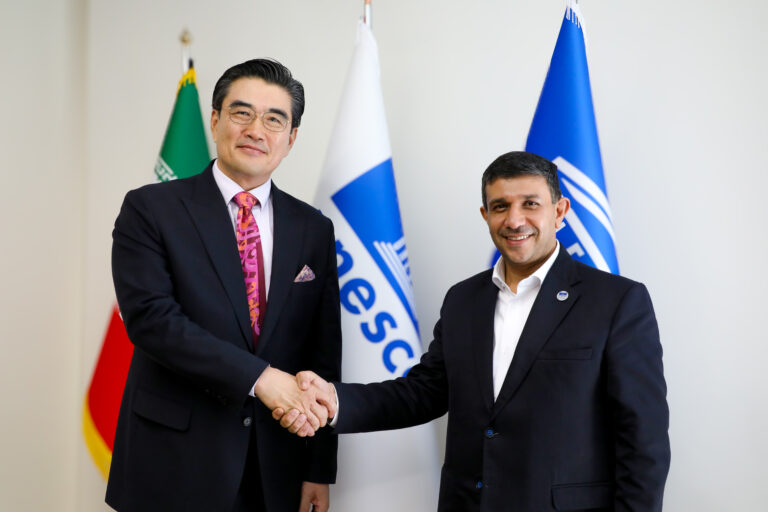
A commemoration ceremony marking the inscription of the Radif of Iranian Classical Music on the World Heritage List was held at Roudaki Hall in the presence of the Secretary-General of the National Commission for UNESCO in Iran.
The commemoration of the inscription of the Radif of Iranian Classical Music on the World Heritage List was held on 15 October 2024, from 6:00 to 8:00 p.m. at Roudaki Hall, with the support of the Faculty of Music of the University of Art of Iran and the Roudaki Foundation, and in the presence of the Secretary-General of the National Commission for UNESCO in Iran.
At the event, Hassan Fartousi, Secretary-General of the National Commission for UNESCO in Iran, stated: “Radif music is the distillation and essence of Iran’s musical culture, to which all the ethnic groups and peoples of this land have contributed: Bayat-e Kord, Shushtari, Gilaki and Christian, Dashtestani and Esfahani, Bayat-e Shiraz, Bayat-e Tork, Bakhtiari, and Dastan-e Arab all testify to this national accord and solidarity. Indeed, the Radif of Iranian music is one of the most comprehensive manifestations of this unity, shaped through centuries of peaceful coexistence.”
Full Text of the Speech by the Secretary-General of the National Commission for UNESCO in Iran:
In the Name of God
May the world never be empty of the lament of lovers…
In his interpretation of Kashf al-Asrar fi ‘Iddat al-Abrar, Meybodi presents a deeply evocative allegory of the layers of the human heart. He explains that the human heart has four veils: sadr, qalb, fu’ad, and shaghaf; each of these veils serves a particular purpose. As the great Nizami says:
Every particle that exists, even if no more than dust,
Has a purpose within the veils of the realm.
Yet the veils of the heart are renowned and honored for a truly momentous task: remembering the beloved and expressing the pain of longing. For any heart that is truly a heart cannot bear to be separated from its beloved even for a moment.
As Sheikh Baha’i says:
For one whose heart is troubled by love,
Every tale they tell becomes enchanting.
And why is the tale of the heart so precious? Because God breathes into the veils of the human heart. And how magnificent is the melody and song that emerges from that divine breath! It is wholly perfumed with the sweet fragrance of love and beauty. This is why, throughout the long and resonant history of Iran, minstrels and musicians have never ceased to lament and celebrate. As Hafez says:
Sing, O lovelorn nightingale, for this is the hour to cry out!
The human being is God’s instrument, and He breathes into the veils of the human heart. The purer and more refined these veils, the more harmonious and beautiful the melodies of devotion.
If you are of angelic nature, begin your journey;
Make this journey more melodious than before.
And the more the passages of the heart become filled with worldly desires and passions, the more, as Rumi says:
Among twenty musicians, if even one plays discordantly,
All lose their way when discord becomes the guide.
A heart filled and burdened with rebellious demons, within and without, has neither movement nor ascent. Pride, greed, avarice, envy, and resentment prevent the heart from becoming harmonious and from keeping in tune with the universal guide. It is in this way that, by emptying the inner self, one begins to seek and breathe in the fragrance of the beloved’s breath through the passages of the heart.
When I became hollow within, like the reed,
I became aware of none but God.
Since I am no longer “I”, O breath that comes from Him,
Before this divine breath, whoever claims a breath of his own is an unbeliever.
Ladies and gentlemen,
The Radif of Iranian Classical Music is the distillation and essence of Iran’s musical culture, to which all the ethnic groups and peoples of this land have contributed: Bayat-e Kord, Shushtari, Gilaki and Masihi, Dashtestani and Esfahani, Bayat-e Shiraz, Bayat-e Tork, Bakhtiari, and Dastan-e Arab all bear witness to this national accord and solidarity. Indeed, the Radif of Iranian music is one of the most comprehensive manifestations of this unity, the product of centuries of peaceful coexistence.
Furthermore, the Radif of Iranian Classical Music is a contribution of Iranian culture to world culture. Its inscription by UNESCO as an element of intangible cultural heritage, in addition to introducing it to the world, means that the international community has a responsibility to safeguard and preserve it. Beyond demonstrating the contribution and influence of Iranian culture in the world, this recognition creates opportunities for greater interaction with other cultures and enhances the cultural standing of Iran in today’s world.
The National Commission for UNESCO in Iran is greatly honored that, through the efforts of the UNESCO Music Committee, established more than 14 years ago with the invaluable support of prominent figures in Iranian music, the dastgahs, avazes, melodies, and gushes comprising the traditional Iranian musical repertoire were inscribed in 2009 on the Representative List of the Intangible Cultural Heritage of Humanity.
An important point, however, is that inscription alone does not fulfil the objective. From UNESCO’s perspective, promotional and educational activities relating to this ancestral art are of vital importance.
I hope that this enduring treasure, which has been passed down to us over the centuries, will, through the efforts of you, the practitioners and custodians of the musical arts, be safeguarded and preserved more than ever and passed on to future generations.
Let me conclude with the eloquent words of Hafez:
The minstrel of love possesses a wondrous melody and song;
Every note he plays finds its way somewhere.
May the world never be empty of the lament of lovers,
For it carries a melodious and joyous breeze.
Thank you.
It is worth noting that several selections from the Radif were performed during the program, including Rang-e Osul, performed by an ensemble comprising Mehdi Darvishmand (santur), Shamim Amani (kamancheh), Mehdi Shirpour (tar), Amirhossein Esfandiyari (oud), and Mohammad Amin Habibi (tombak); Montazam al-Hokama’s tale, performed on setar by Babak Raheti; the Aqa Hossein Qoli Radif, performed on tar by Amirhossein Saleh Karimi; the Habib Samai Radif, performed on santur by Aref Shahednavaz; the Morteza Neydavood Radif, performed on tar by Ali Samadani; a musical tradition from Azerbaijan, performed on kamancheh by Hossein Towhidvand; the Ali-Akbar Shahnazi Radif, performed on tar by Sama Mahmoudi; the Ali Tajvidi Radif, performed on violin by Behrang Azadeh; the Abolhasan Saba violin Radif, performed on kamancheh by Shamim Amani; and a performance of Masnavi recitation by Hassan Kasaei, accompanied on ney by Zaman Kheiri.
Dr. Houman Asadi also delivered a speech on the Radif and its inscription; Dr. Tara Elahverdi spoke about the performances of Esmail Ghorbani; and Dr. Babak Khazraei spoke about the practice and transmission of the Radif.