Khaled El-Enany Elected as UNESCO’s New Director-General
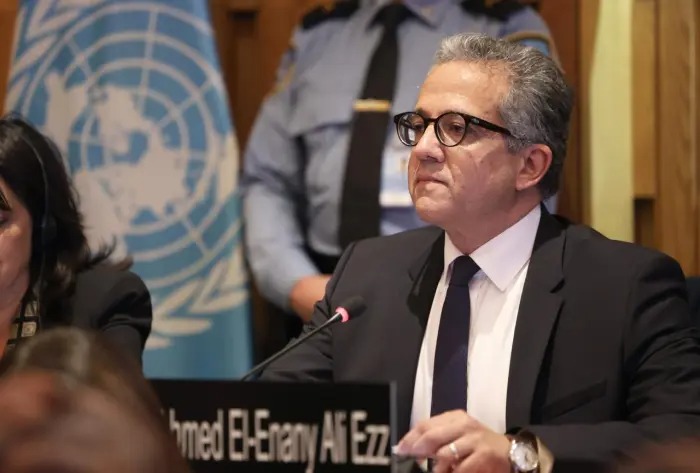
UNESCO Executive Board Votes Overwhelmingly in Favour of Egyptian Candidate On 6 October 2025, during the 222nd session of UNESCO’s Executive Board in Paris, Khaled Ahmed El-Enany, Egypt’s former Minister of Tourism and Antiquities, was elected as the new Director-General of the United Nations Educational, Scientific and Cultural Organization (UNESCO), receiving 55 of the 57 votes cast. At the session, El-Enany prevailed over Firmin Édouard Matoko, the candidate from the Republic of the Congo, who had served as UNESCO’s Deputy Director-General and, until March, had been responsible for the Organization’s external relations. His election formally sets UNESCO on a new leadership course at a particularly critical time for the world. |
With Khaled El-Enany’s election, for the first time in history, a figure from the Arab world—and only the second person from the African continent, after Amadou-Mahtar M’Bow of Senegal, who served as Director-General from 1974 to 1987—will take the helm of UNESCO. He will succeed Audrey Azoulay, UNESCO’s French Director-General, whose tenure came to an end after two four-year terms. El-Enany is scheduled to officially take office on 14 November 2025.
An Egyptologist with an International Background
Khaled Ahmed El-Enany, born in 1971, is a professor of Egyptology at Helwan University in Egypt and has more than three decades of experience in education and research. He earned his PhD from Paul-Valéry Montpellier 3 University in France and has taught there on several occasions as a visiting professor.
El-Enany previously served as Director of the National Museum of Egyptian Civilization from 2014 to 2016 and Director of the Egyptian Museum in Cairo from 2015 to 2016. He then served as Egypt’s Minister of Antiquities and, subsequently, Minister of Tourism and Antiquities from 2016 to 2022.
A New Vision for UNESCO
In his remarks following his election, Khaled El-Enany emphasized the importance of strengthening cultural dialogue and rebuilding trust among Member States. He also stated that, during his term, particular attention would be given to World Heritage, sustainable education, and countering hate speech and cultural extremism.