Minister of Science: University Media Must Build Credibility and Trust / World Communications and Public Relations Day Meeting Highlights Crisis Communication in Higher Education
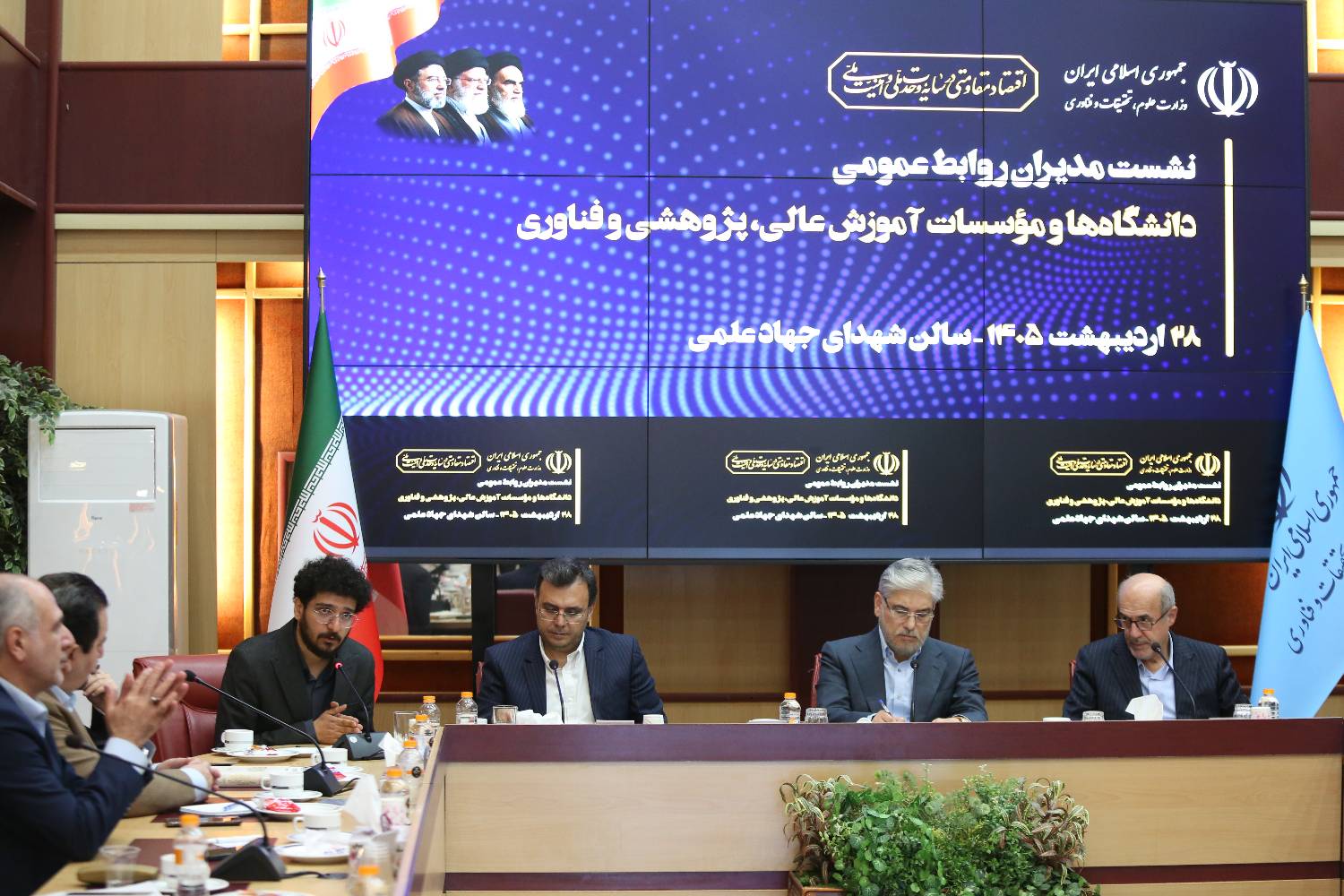
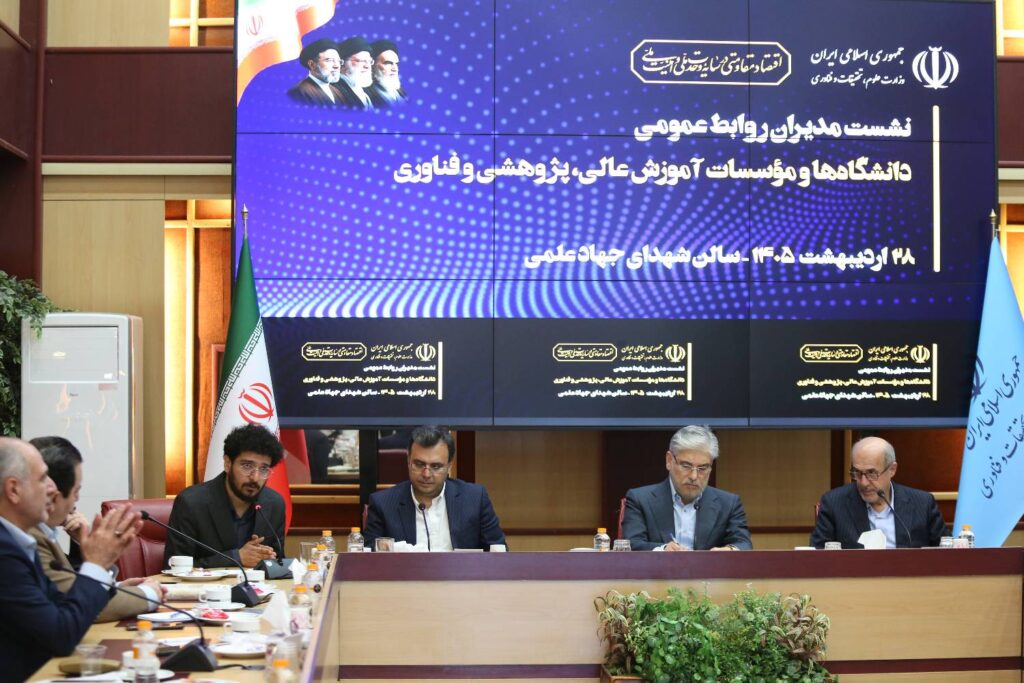
On the occasion of World Communications and Public Relations Day, a specialized meeting was held with the participation of university public relations directors and officials from the Ministry of Science, Research and Technology. The meeting emphasized crisis communication, rebuilding public trust, strengthening the media credibility of universities, and the need to transition from ceremonial public relations to a strategic approach. |
At the meeting, Dr. Hossein Simaei-Sarraf, Minister of Science, Research and Technology, referring to the complex circumstances facing the country in the economic, military, and media spheres, stated: “Today, we are not engaged solely in a military war; we are also in the midst of a media war, and we must assess how successfully we have performed on this front.”
Emphasizing that the media are not merely a tool for disseminating information, he said: “Media means communication; it means initiating a dialogue and assuming responsibility for its consequences.”
Criticizing the transformation of some university media outlets into ceremonial platforms, the Minister stressed: “University media must establish themselves as credible sources. Sometimes, an authentic and human account of a professor’s or student’s sacrifice can have a far greater impact than dozens of official and administrative news reports.”
Dr. Simaei-Sarraf also emphasized the need to strengthen media literacy in academic environments, adding: “Good intentions are not enough in the media; the social impact and consequences of a message must also be assessed. Even the slightest media-related lapse can impose costs on a university and the higher education system.”
At the meeting, Dr. Hadi Khaniki, a journalist, media specialist, and distinguished professor of communication studies, referring to this year’s World Communications Day theme, “Enabling Resilience in a Connected World,” described today’s society as “a connected world exposed to disruption.”
Referring to technical and social disruptions in the field of communication, he said: “We live in a networked world, yet at the same time we face internet restrictions, media polarization, and social divides. These conditions disrupt mutual understanding and weaken social cohesion.”
Communication Competence: A Pressing Need for Iranian Society
Dr. Khaniki identified “communication competence”—the ability to communicate effectively, appropriately, and accurately with others in different situations—as one of the most pressing needs of Iranian society today. He added: “Communication is not merely a technical infrastructure; listening to others, upholding human dignity, and creating opportunities for dialogue are also integral to it. In times of crisis, a single-voice approach multiplies communication breakdowns.”
Emphasizing the importance of the social middle ground and intermediary media, he proposed that each university establish a dialogue-oriented media platform involving faculty members, students, and public relations teams to facilitate dialogue and collective narratives about crises.
In another part of the meeting, Dr. Saeed Habiba, Deputy Minister of Science and Head of the Student Affairs Organization, described public relations professionals as “ambassadors of awareness and pioneers of storytelling at universities,” stating that effective communication is indispensable to scientific, economic, and social development in the modern communications era.
Strategic Public Relations: From Narrative Management to Rebuilding Public Trust
Dr. Vahid Shalchi, Deputy Minister of Science for Cultural and Social Affairs, also referred to developments in the digital world and the rapid circulation of news and narratives, stating: “In today’s networked world, public relations is no longer merely about publishing news; it involves strategic media management, building trust, and establishing social legitimacy.”
He added that, in an environment where algorithms can build or destroy trust in a short period, the responsibilities of public relations professionals have become considerably more challenging and sensitive.
The Crisis of Crisis Communication: A Warning for the Higher Education System
Dr. Amirhossein Mousavi, a communication specialist and researcher, stated: “Public relations is a decision-making management approach whose purpose is to establish mutually beneficial relationships between organizations and their stakeholders through the provision of information and the use of reliable and ethical communication methods and tools. Its aim is to build trust among stakeholders, protect and enhance an organization’s credibility and reputation, and bridge divides.”
Referring to the “crisis of crisis communication” in the country, he said that many national issues escalate from ordinary problems into crises and even disasters because of insufficient knowledge of crisis communication. He stressed: “Crisis communication must serve as a balm for society’s wounds, not as a factor that deepens misunderstanding and mistrust.”
Dr. Mousavi identified five challenges facing crisis communication in the country: neglect of crisis communication expertise and the lack of training; the mistaken assumption that all problems are communication problems; an exclusive focus on “narrative” while disregarding real-world conditions; misconceptions about public relations and its impact on the erosion of social capital; and insufficient attention to the philosophical assumptions and fundamental values underlying crisis communication.
Concluding his remarks, Dr. Mousavi emphasized: “The tools of crisis communication management are not suppression, silencing dissenting voices, one-sided narratives, advertising, or propaganda. Rather, they are communication grounded in humility, accountability, empathy, and a commitment to honesty and transparency from the very outset. Today, this is essential not only for ethical reasons but also as a matter of practical necessity.”
At the end of the meeting, Dr. Mohammad-Ali Dadgostarnia, Director of Public Relations and Media Adviser to the Minister of Science, thanked the speakers and participants, emphasized the continuation of specialized meetings and programs on crisis communication, both in person and online, and called for the practical application of these discussions at universities.
The Public Relations Officer of the Iranian National Commission for UNESCO also attended the meeting.